Learn about the dinosaurs

Dinosaurs

Meet
our dinosaurs

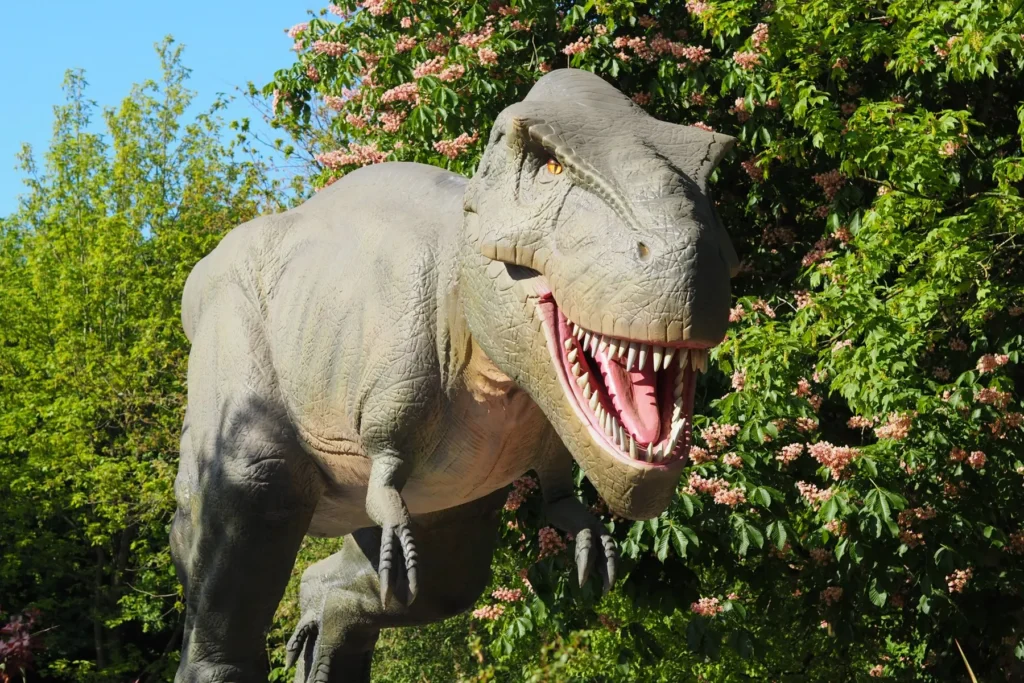
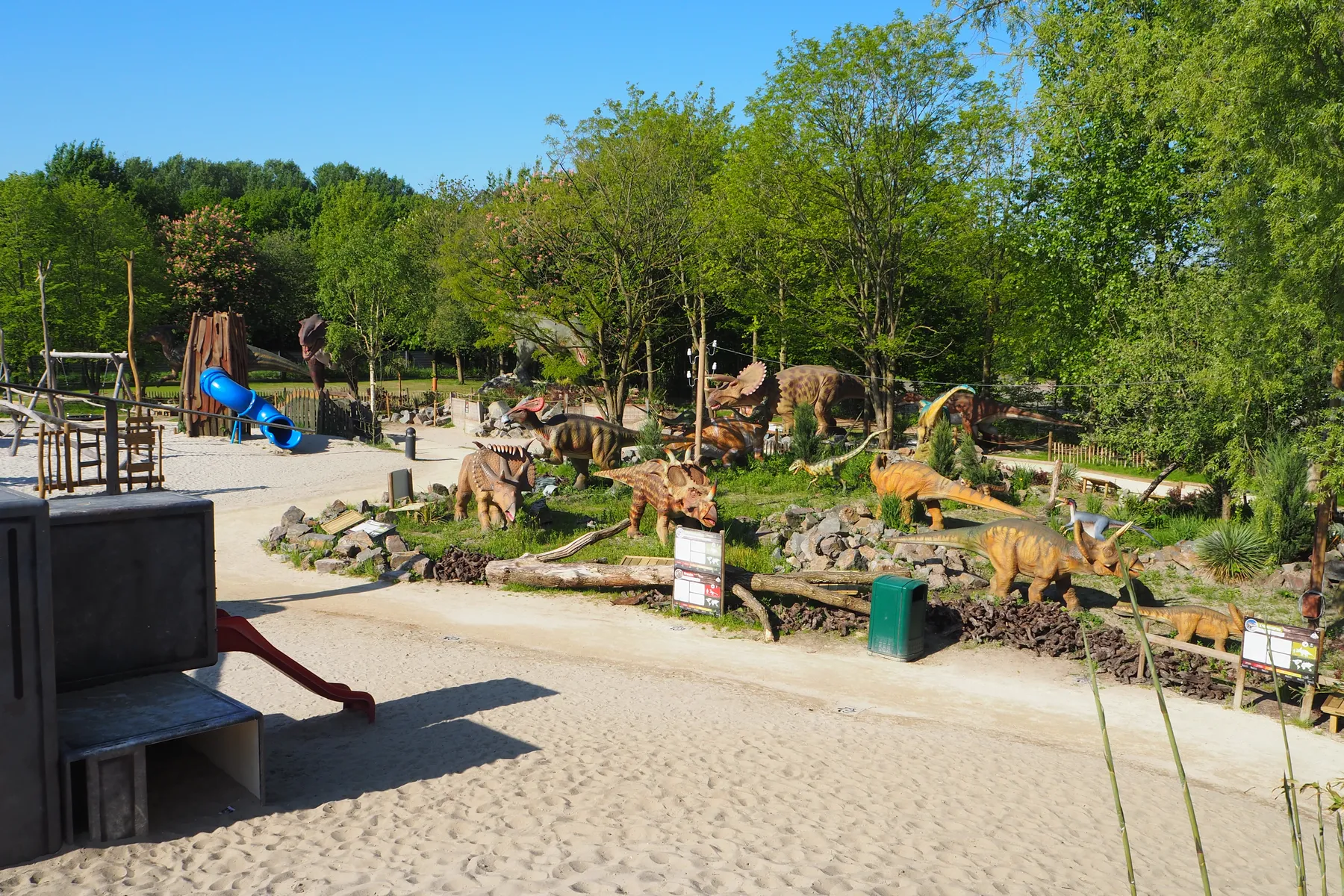
Dinosaurs used to be huge. This is probably because there was more oxygen in the air than today. Also, during the dino era a lot warmer. Many of the dinosaurs that are in Dinoland are actual size. So you can easily see how big they really used to be. On this page you will learn fun facts about their size, weight, habitat and the era they lived in.

Allosaurus

This dino looks very much like a T. rex, but it is not. It has 3 fingers instead of 2 and was a lot lighter. Also, its head was a narrower. Scientists think the Allosaurus could reach 30 kilometers per hour. Whether the Allosaurus lived in groups or alone, no one knows. Opinions differ on it.

Meaning name: Deviant lizard
Weight: 1000 kilograms
Size: 8.5 meters long and 3 meters high
Era: Jura
Type: Meat Eater

Allosaurus 2 2

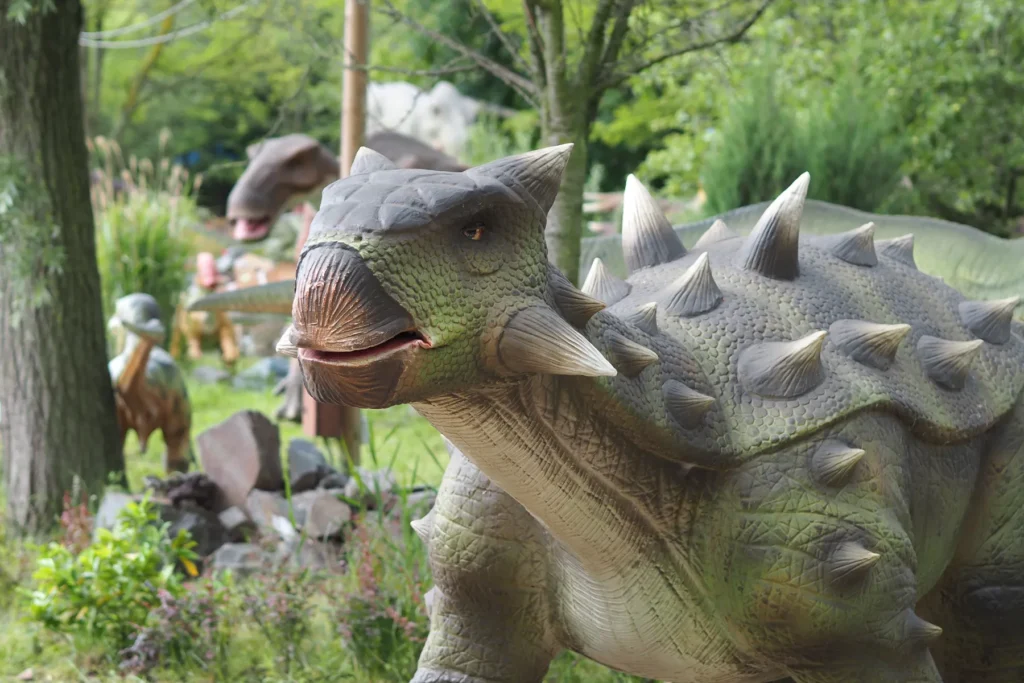
Ankylosaurus

The Ankylosaurus was so well armored that it had almost no enemies. With the mace on its tail, it could knock others away in an instant. Its hard shield allowed it to take blows and bites well. Only large dinosaurs like the T. rex or the Giganotosaurus saw him as good food.

Meaning name: Rigid reptile. Because it was a kind of walking tank.
Weight: 3500 to 6000 kilos
Size: 6 to 8 meters long and 2 meters high
Era: Late Cretaceous
Type: Plant Eater

Ankylosaurus 2 3

Brachiosaurus

This giant dinosaur could eat the tallest leaves from the trees with its long neck. Didn't succeed? Then he simply pushed the tree over! The Brachiosaurus was so heavy that the ground shook when it walked by. Because Brachiosaurus was so big, it had no natural enemies.

Its neck was half its total height. Its tail was smaller than that of other long-necked herbivores. It is suspected that the brachiosaurus lived in herds of about 20 animals. Scientists believe it could have lived to be as long as 100 years old.

Meaning name: Arm lizard. Because its front legs were longer than its hind legs.
Weight: 35,000 kilograms
Size: 25 meters long and 15 meters high
Era: Jura
Type: Plant Eater

Brachiosaurus 2 27

Carnotaurus

Little is known of the Carnotaurus. The only fossil found was incomplete. The legs and a piece of the tail were missing. However, there was an imprint of the skin next to it. That imprint also gives much insight on the skin of other theropods.

It seems that the Carnotaurus could run fast. Scientists think that this hunter made a dash to catch its prey. It did not have a lot of biting power and probably used its horns to give its prey a push.

Meaning name: Carnivorous bull
Weight: 2100 kilograms
Size: 7.5 meters long and 3 meters high
Era: Late Cretaceous
Type: Meat Eater

Chalk Carnotaurus 54

Deinonychus

The Deinonychus had feathers and walked on its hind legs. It probably could not fly because it was too heavy for that. Because of this half bird, half reptile dino, scientists believe that modern birds are also descended from dinosaurs.

The ‘Raptors’ In Jurassic Park are actually Deinonychuses. The author of the original book took an idea from a paleontologist as fact. The paleontologist wrote that he thought Raptors and Deinonychus were very similar and thought they should just be in the family together. Later that changed.

Meaning name: Terrible claws
Weight: 75 to 80 pounds
Size: 2 meters high and 3.5 meters long
Era: Chalk
Type: Meat Eater

Deinonychus Large 33

Dilophosaurus

Dilophosaurus was no cutie pie. It probably hunted smaller, weak prey in groups. They could run fast and with its sharp teeth it gripped its prey well. What the two crests on its head were for, scientists have not yet decided.

Meaning name: Lizard with two combs
Weight: 400 kilograms
Size: 6 meters long and 1.50 meters high
Era: Early Jurassic
Type: Meat Eater

Dilophosaurus 35

Kentrosaurus

The Kentrosaurus resembled a Stegosaurus, but with spines instead of plates on its back.

This clumsy animal was not very fast. To scare enemies away he used his spines. He waved his tail and perhaps made some angry noises.

Meaning name: Spiny Saurian
Weight: 700 kilograms
Size: 4.5 meters long and 2 meters high
Era: Jura
Type: Plant Eater

Kentrosaurus 47

Megalodon

Megalodon was a huge shark that got teeth as big as a human hand. The Megalodon could open its mouth as much as 2 meters. So an adult human could easily stand upright in it.

The last Megalodon sharks still swam around when humans already walked the earth. Nowadays there are only many teeth left, including in the Netherlands.

Meaning name: Large tooth
Weight: 12,000 to 14,000 pounds
Size: 18 meters long
Era: Miocene, 43 million years after the Cretaceous
Type: Meat Eater

Megalodon

Megapnosaurus

When the Megapnosaurus was first named, it was accidentally given the same name as a beetle. Years later, an observant beetle expert only found out.

Megapnosaurus was a carnivore that probably hunted in groups. Mostly on smaller prey, but perhaps they dared to attack large herbivores in groups as well.

Meaning name: Large dead lizard
Weight: 13 kilograms
Size: 3 meters long
Era: Early Jurassic
Type: Meat Eater

Megapnosaurus 51

Parasaurolophus

The Parasaurolophus had a long crest with which it could make sounds. He used it to warn conspecifics of danger or to lure a mate.

With its beak-like beak, it could pick fresh leaves from trees. The parasaurolophus had no teeth on the front of its beak.

He usually walked on 4 legs, but could balance on his hind legs for a while. For example, to reach tall leaves or scare off enemies.

Meaning name: Dinosaur with crest
Weight: 3500 to 4000 kilos
Size: 8 to 10 meters long and 5 meters high
Era: Chalk
Type: Plant Eater

Parasaurolophus 74

Pteranodon

The Pteranodon was not actually a dinosaur, but a flying reptile. It resembled a kind of pelican, but with wings reminiscent of a bat.

He flew over the water and scooped out all kinds of sea creatures with his mouth. The Pteranodon also really liked to eat the eggs of other dinosaurs.

Like the wings of a bat, the wings of the Pteranodon consisted of a light flexible and strong skin. Each wing ran from the long fourth finger of the foreleg all the way to the hind leg. The Pteranodon was not even very large; its relative the Quetzalcoatlus could reach a wingspan of up to 20 meters.

Meaning name: Toothless mouth
Weight: 22 kilograms
Size: 4 to 6 meters wide and 1.7 meters high
Era: Triassic, Jurassic and Cretaceous
Type: Meat Eater

Pteranodon 77

Scelidosaurus

The Scelidosaurus was full of short spines all over its body. It used these to protect itself from enemies.

It was a herbivore that could not chew properly. Leaves were pulled from bushes and swallowed immediately.

Meaning name: Carbone lizard. Due to a spelling error, this name was chosen instead of ‘hind leg lizard.
Weight: 250 kilograms
Size: 4 meters long and 1.20 meters high
Era: Jura
Type: Plant Eater

Scelidosaurus 80

Spinosaurus

The Spinosaurus was the largest carnivore of all dinosaurs. It was even 4 meters longer and 4,000 pounds heavier than the T. rex. The Spinosaurus had a long mouth with many sharp teeth. The mouth had a curve in it so that it could hold fish well. The fish the Spinosaurus ate were 5-meter-long swordfish!

He also liked to eat dinosaurs: with his 2.2-meter-long, powerful arms he knocked them down. On his back he had a large sail; we do not yet know exactly why he had it.

Meaning name: Thorn lizard
Weight: 12,000 kilograms
Size: 18 meters long and 7 meters high
Era: Chalk
Type: Meat Eater

spinosaur 82

Stegosaurus

The Stegosaurus was a herbivore that grazed all day. It moved slowly, so it had to defend itself well.

The plates on its back regulated its body temperature and provided extra protection. The Stegosaurus was the size of an elephant, but had a very small head. Its brain was only 2.5cm long and weighed no more than one thousandth of its total body weight. Therefore, you could also call the Stegosaurus ‘the dumb dino.

Still, you had to watch out for him. For his tail had two pairs of pointed spines with which he could deliver a deadly blow.

Meaning name: Lizard with roof
Weight: 3000 kilograms
Size: 9 meters long and 2.75 meters high
Era: Jura
Type: Plant Eater

Stegosaurus 83

Suchomimus

This giant's favorite food was fish. He may have stood at the edge of a small lake to scoop fish out of the water. Or he swam through the water and caught fish by swimming after them.

The Suchomimus, like the Spinosaurus, had a crest on its back. What it was for is still a mystery.

Meaning name: Crocodile Nibbler
Weight: 3000 kilograms
Size: Almost 10 meters long and 3 meters high
Era: Chalk
Type: Carnivore, especially fish

Suchomimus 86

Triceratops

The Triceratops was heavily built and had 2 long horns above its eyes. Triceratops looked after their young well, forming a protective circle around their children in case of danger.

Almost all predators were afraid to fight the Triceratops, except the T. rex. The T. rex did not always win against the Triceratops; fossils have been found of wounds that had time to heal. This indicates that the Triceratops had survived the fight.

Meaning name: Face with 3 horns
Weight: 6,000 pounds
Size: 9 meters long and 3 meters high
Era: Late Cretaceous
Type: Plant Eater

Triceratops 3 91

Tyrannosaurus rex

This fearsome dinosaur was one of the largest carnivorous land animals ever. With its 30 cm long teeth, very good eyes and gigantic biting power, its prey didn't stand a chance. He devoured them in 1 bite.

But did the T. rex itself have anything to fear? Yes, but that danger came from an unexpected quarter. In fact, studies show that the T. rex suffered greatly from parasites!

Meaning name: Cruel king of dinosaurs
Weight: 7000 kilograms
Size: 13 meters long and 3.5 meters high
Era: Chalk
Type: Meat Eater

T-Rex

Velociraptor

This small but clever hunter was covered in a layer of feathers and looked a bit like a bird. Yet he was much more dangerous!

The Velociraptor's wings were too small to fly with, but it had large hand claws with three fingers with which it could properly grab and hold its prey.

He had a strong flexible neck. That way he could tear the meat out of a carcass without difficulty.

Meaning name: Fast rover
Weight: 20 kilos
Size: 2 meters long and 60 cm high
Era: Chalk
Type: Meat Eater

dinoland velociraptor

More fun facts

Is your son or daughter giving a talk about dinosaurs? If so, Dinoland can help. Download the talk of plan a visit To Dinoland. Here you will find many dinosaurs with accompanying information.

  • Were the spines of dinosaurs sharp? +

    Some dinosaurs, for example the Kentrosaurus or the Stegosaurus, had spines. They probably used these to defend themselves. These spines did not have to be sharp. The muscles around them allowed the dino to use a lot of force and deliver a big blow.

  • How do you know if a bone is real? +

    To see with the naked eye whether a fossil is real you must have studied. Radiometric dating allows scientists to see how old a fossil is. Then you can also tell right away whether it is a bone or a piece of stone. Radiometric dating sounds very complicated, but it's easy to explain. Every bone contains tiny radioactive particles. Over time, those particles change into a different substance. By looking at what percentage of each substance is in the bone, one can say approximately how old a bone is. It also sometimes looks at the layer of earth the fossil was found in.

  • What kind of weather was it? +

    In the Triassic, it was hot and dry. Even at the North and South Poles, there was no ice. Only ferns and other plants with only green leaves grew. There was also more oxygen in the air. This allowed dinosaurs to grow bigger and bigger.

  • Where can you find dinosaur fossils? +

    In the old days, there were no continents. All the land was attached to each other. That huge piece of land is what we call Pangea. So dinosaurs could easily walk all over the earth. That's why dino fossils can be found all over the world. During the Triassic, Pangea began to drift apart again and dinosaurs had to stay on their own part. Most T. rexes can be found in the Americas.

Search the website